Mental Health Awareness Week (14-20 May 2018)
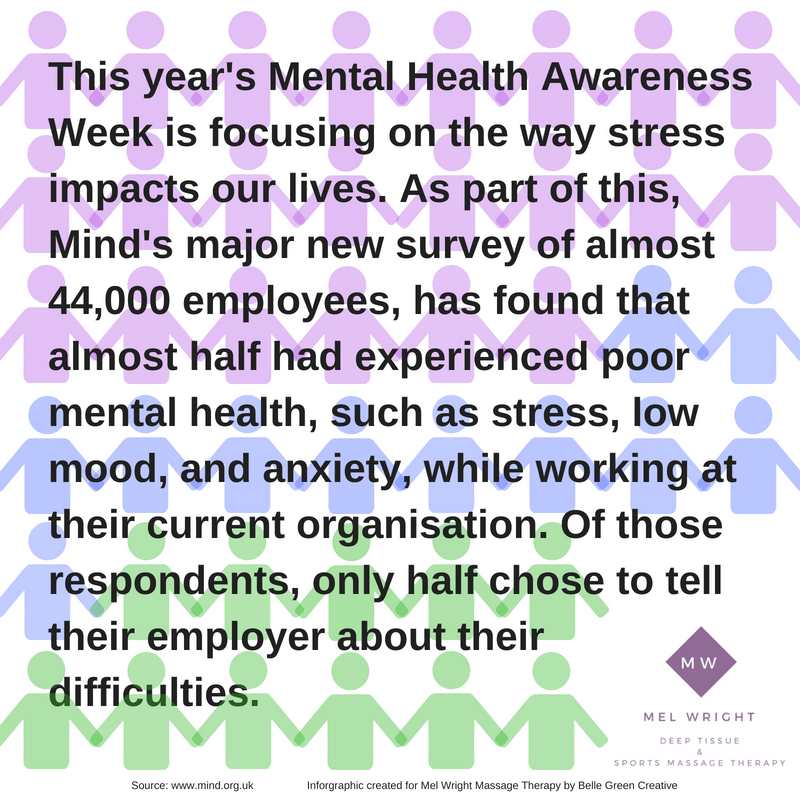
Approximately 1 in 4 people in the UK will experience a mental health problem each year [1] and in England alone, 1 in 6 people report experiencing a common mental health problem (such as anxiety and depression) in any given week [2].
Some months ago, a client of mine suggested to me that as part of my blog series I write something on the benefits for massage for those living with mental health conditions. I’ve had it written and sat on my PC for a while now, trying to decide if it’s the right thing to post, of any interest, or even any use to anyone, but with Mental Health Awareness Week taking place this week with a focus on stress, I thought perhaps I should.
Across the country there is an increased awareness of mental health conditions, which in turn is leading to a greater debate about their impact on those living with the conditions. In my opinion, with this comes the responsibility to be well informed if you are going to enter the discussion and not appear ill-informed, patronising or judgmental. I’ve thought long and hard about the request to put together a blog on the benefits of massage for those living with mental health conditions and I’m approaching this blog with some trepidation; because mental health conditions are as wide ranging as physical health conditions . I wouldn’t write about the benefits of massage for people living with sciatica, arthritis and/or high blood pressure in the same blog, so why would I try to cover stress, anxiety, borderline personality disorder or depression in the same post. Sadly its too easy for us to put all mental health conditions into one bucket and address them as one homogenous thing, rather than try to understand the difference of each.
Whilst I could write a series of posts on the benefits of massage for each different mental health condition there are two reasons I don’t want to take that approach, I don’t want to risk trivialising mental health conditions, extolling the virtues of massage in such a way that I write a sales pitch, and whilst I can read and research the topic(s) I don’t believe I would feel well enough informed on the breadth and depth of the subject to give it the care and attention it deserves.
What I’m going to talk about here is how stress, the focus of Mental Health Awareness Week and something we all experience to some degree at varying points in our lives, can manifest itself in our bodies without us recognising it as such. The client I’m writing about has given me their consent to write about them, but I’m doing so in a way that’s gender neutral and they can’t be identified from it, in fact on reading it back I can see several people I know in the description of this client, from my wife, to friends, clients and other family members.
The client concerned got in touch because they thought they may have trapped a nerve and for weeks they had been experiencing excruciating pain in their lower back that they thought may be a trapped nerve. As they walked down the path to the treatment room I could see the pain across their face; rating their pain, something I ask all clients to do if they are reporting pain, they told me that morning was feeling like a 7/10, whereas the day before had been a 9/10. Filling in their client form they seemed to be a generally fit, active and healthy person in their early-40s, and it was only later in the appointment that I thought back to them fidgeting while filling in the form and hesitating over where to tick yes or no on something.
Once they were on the table I could feel something different in their muscles to the description they’d given. To give them the treatment that their body was telling me it needed I had to address the nagging doubt in my mind that said don’t pry into someone’s private life, I bit the bullet and asked “ how are things in your life, do you think this pain could be stress related? ”. I was taking a risk asking the question, but it felt right. What I got was a look of (unnecessary) shame and relief – someone knew, but also someone reaffirmed something they hadn’t wanted to admit to themselves. We talked about their:
·home life children, stay-at-home parent partner, parent carer responsibilities, mortgage that was too big,
·work life - new job, progressing in their career, climbing the corporate ladder, taking on more responsibilities, never giving up, rarely switching off,
·social life – mostly business related from time to time, but who has time to spend with friends and have meaningful engagement, occasional texts and infrequent face to face contact were their default, and
·how the pressures they and others placed upon them had built up to the point they were feeling unable to cope.
Your muscles tense up to protect themselves from injury when you’re stressed and tend to release again once you relax, but if you’re constantly under stress, your muscles may not get the chance to relax with frequently or persistently tight muscles causing headaches, back and shoulder pain, and body aches. And so, with this particular client, I moved away from the area they were describing as the source of their pain and discomfort and focussed on giving a therapeutic, relaxing massage, working on all the muscles across their neck, shoulders and back where I could feel tension was being carried, but nothing to indicate a trapped nerve. As I talk about in one of my earlier blogs ( Massage & Relaxation) massage isn’t just about manipulating soft tissue; it’s about therapeutic touch too. Of course, their stresses haven’t gone away from having a massage, but their self-assessed pain level had dropped afterwards, they carried themselves a little differently and I hope that by having someone recognise that they were stressed and that its ok to be stressed they might feel a little more capable of looking at how those pressures have built up and up and seeking out ways of making them manageable again.
If any of what I’ve written here feels familiar to you and you’d like to know a little bit more, I’d recommend:
·The NHS’ One You page,
· MIND, the UK charity working for better mental health for everybody are behind the Mental Health Awareness Week (14-20 May) and also provide a guide to massage for those with mental health conditions; and
· HeadsTogether who aim to promote positive conversations about living with mental health conditions.
And of course there’s always your GP. If stressed is becoming a long-term way of living for you, do seek out support mechanisms.
Best wishes,
Mel
References
[1] McManus, S., Meltzer, H., Brugha, T. S., Bebbington, P. E., & Jenkins, R. (2009). Adult psychiatric morbidity in England, 2007: results of a household survey. The NHS Information Centre for health and social care.
[2] McManus S, Bebbington P, Jenkins R, Brugha T. (eds.) (2016). Mental health and wellbeing in England: Adult psychiatric morbidity survey 2014. Leeds: NHS digital.